Receding Gums Treatment in Frisco, TX
Recession has four common causes and they need four different answers. Treating the wrong one is why people spend years watching it get slowly worse.
Receding gums causes: how we find out why yours is receding
This is the whole of the appointment. Four causes look similar in the mirror and lead to completely different treatment, and getting the cause wrong is why recession keeps progressing while somebody is being treated for it.
Gum disease
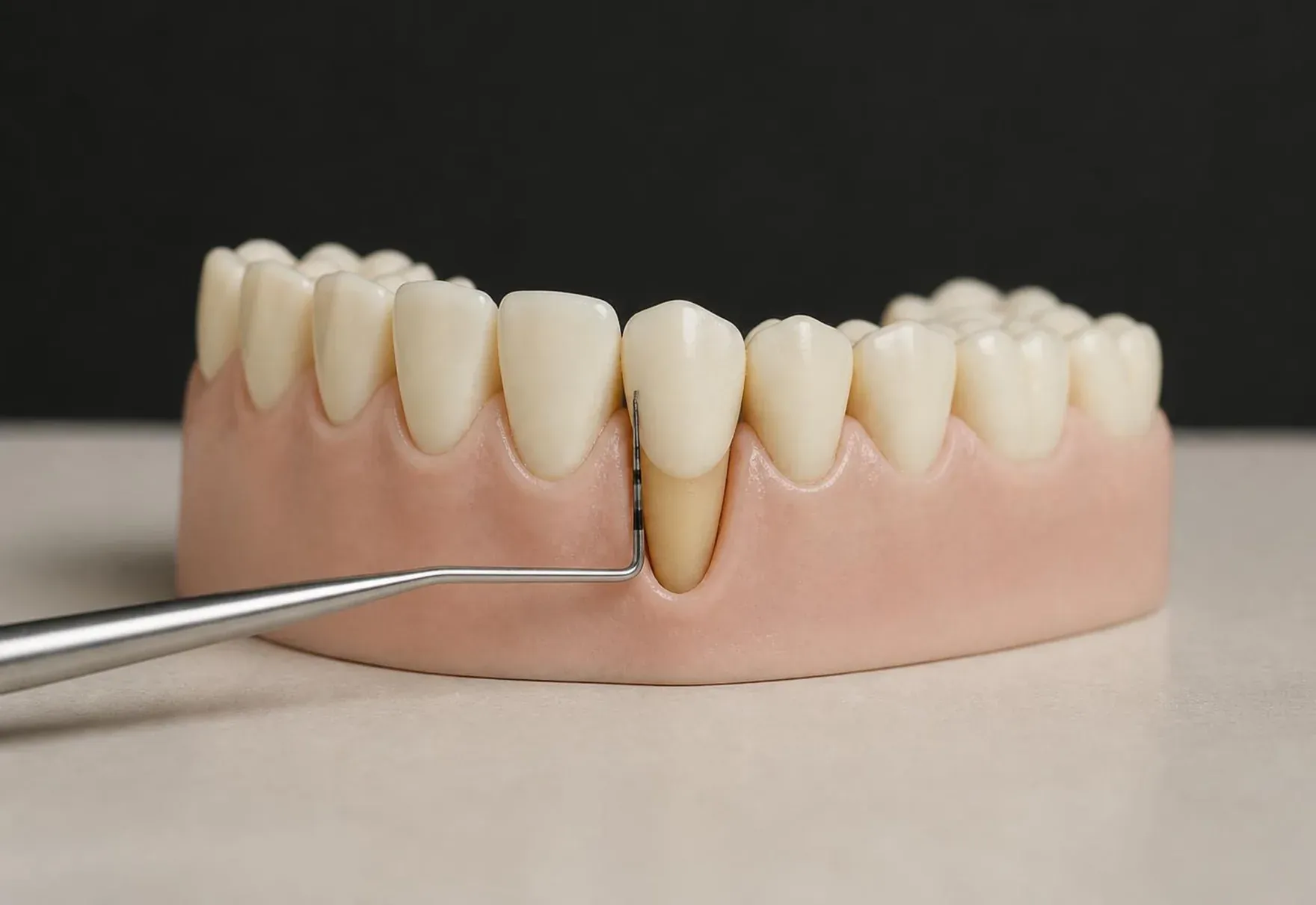
Inflammation destroying the bone and attachment around the tooth, with the gum following it down. This shows as deeper pockets and bone loss on X-ray. Treating the disease is the answer here, and grafting into untreated gum disease is grafting onto a problem that is still running.
Brushing technique
The most common cause in people whose gums are otherwise healthy — a hard brush, a scrubbing action, and often years of doing it conscientiously. It usually shows as clean, sharply defined recession with no inflammation and sometimes a worn notch at the gumline. Changing the technique matters more than any procedure, because a graft placed under an unchanged habit recedes again.
The tooth's position in the bone
A tooth sitting outside the arch of bone has very thin bone and gum over its root to begin with. Lower front teeth and upper canines are the usual sites. Nothing was done wrong; there was very little there to begin with. This is the situation where grafting is most clearly the right answer, and it is also the one orthodontics can sometimes make worse or better.
Grinding and bite forces
Heavy clenching flexes a tooth at the gumline and is associated with recession and with wedge-shaped notches in the root surface. A night guard addresses the cause. Restoring the notch on its own repairs damage while the grinding that caused it keeps going.
Choosing treatment once the cause is clear
Once the cause is clear the options are honest and few: stop the cause and monitor, restore a sensitive or notched root surface, or graft to cover the root and rebuild a band of gum. Plenty of recession needs only the first of those.
Receding gums: what to know first
Can receding gums grow back?
Gum tissue that has receded does not grow back on its own. No toothpaste does it, no mouthwash does it, no oil pulling does it, and no supplement does it. Anything advertised as regrowing receded gums is selling you something. What is true is that recession can be covered surgically with a graft, and that in the right case the result is stable for decades and looks like it was always there. It is also true that a great deal of recession does not need covering at all. If it stays symptom-free, with no sensitivity, no worsening, no exposed root and nothing you notice in the mirror, monitoring it properly is a legitimate treatment. We will tell you which of those you are, and we would rather be the practice that talks you out of surgery than into it.
The unglamorous thing that stops most of it
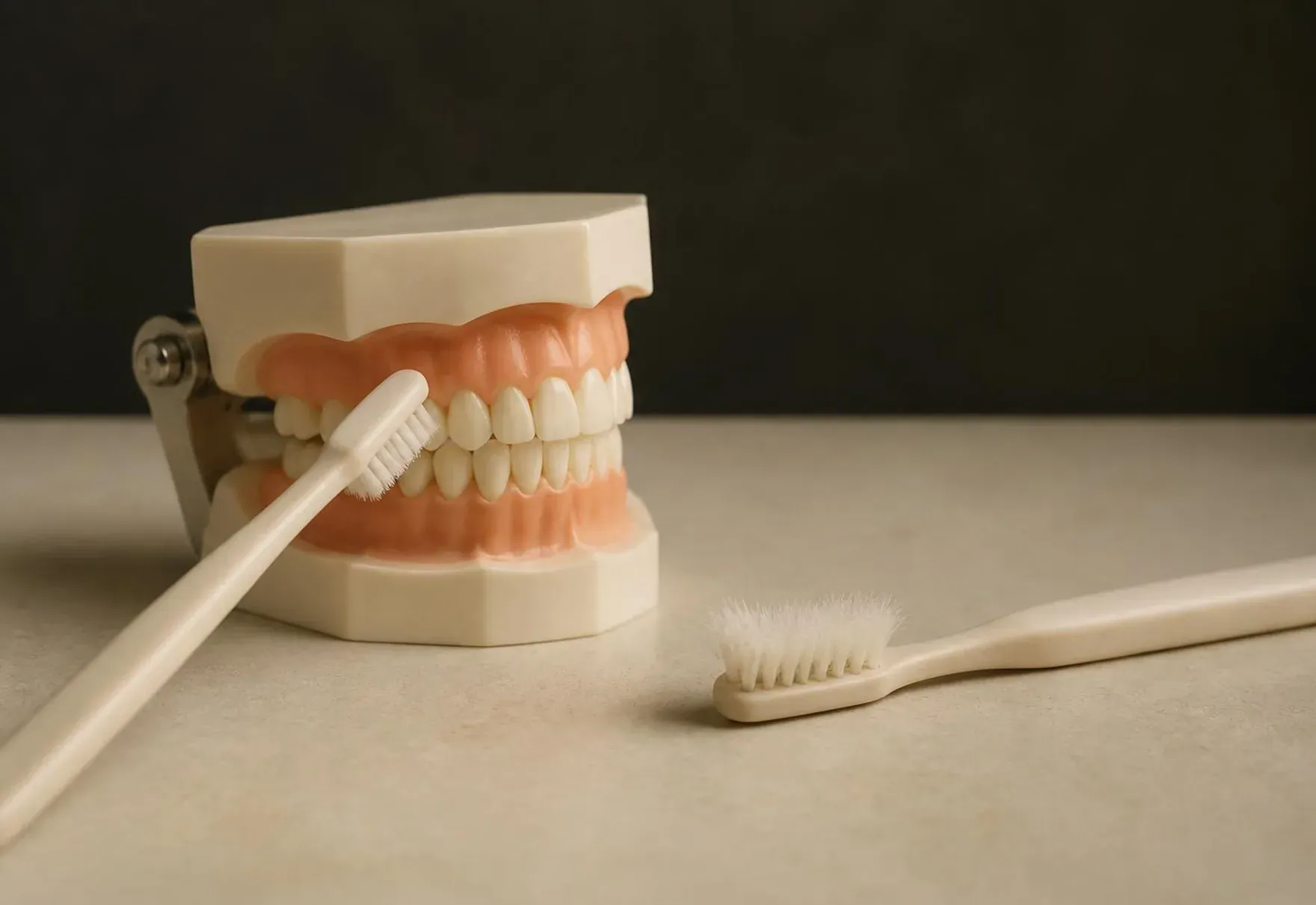
For recession caused by brushing, changing how you brush is the treatment, and it works. Use a soft brush, genuinely soft and not "medium", held at an angle to the gumline and moved in small circles, not scrubbed back and forth. An electric brush with a pressure sensor is worth its cost here purely because it stops you pressing. It takes about two minutes to be shown properly and most people have not been shown at all, because it is the least billable thing in dentistry. Your hygienist will do it at your next visit, with a mirror, and will watch you do it back.
Receding Gums near Frisco, Prosper and Plano
Receding gums are assessed in our office at 8175 Custer Rd, Suite A110, Frisco, TX 75035, and gum grafting, where it is needed, is done here by Dr. Holvin Louie, our board-certified periodontist. We are open Monday, Tuesday, Thursday and Friday from 9 AM to 6 PM and Saturday from 9 AM to 3 PM. Wednesday and Sunday we are closed, though the phone is still answered on Wednesday. Patients come from Frisco and from Prosper, Plano, Little Elm, Allen, Celina and McKinney.
Call (469) 262-2111Receding gum treatment options by cause
The same appearance, four different right answers.
| Cause | What actually helps |
|---|---|
| Gum disease | Treat the disease first — scaling and root planing, then maintenance. Graft later if still needed. |
| Brushing technique | Change the technique. Soft brush, correct angle, pressure sensor. Graft only if it is severe or progressing. |
| Tooth outside the bone | Grafting is most clearly indicated here, because there was not enough tissue to begin with. |
| Grinding | A night guard. Restore the notch if sensitive. Grafting alone will not hold under continuing force. |
| A pulling frenum | Release the frenum, then graft if recession is significant. |
| None of the above — not progressing | Measure it, photograph it, and watch it. This is a real answer. |
Receding gums treatment starts with finding the cause, because gum disease, brushing, tooth position and grinding each need a different answer. At White Lotus Dental in Frisco, the assessment is part of your exam, and Dr. Holvin Louie, our board-certified periodontist, does gum grafting when it is needed.
What to do this week, before any appointment
Three things, none of which cost anything, and all of which are worth doing whether or not you end up needing treatment.
Look at your toothbrush. If the bristles are splayed outward, you are pressing far too hard. If it says “medium” or “firm” on the handle, replace it with a soft one today. There is no dental reason to own a firm toothbrush.
Change the motion. Small circles at the gumline, brush angled toward the gum, letting the bristles do the work. Not a horizontal scrub. If you use an electric brush, guide it and let it run — do not scrub with it as well.
Take a photograph. Phone camera, good light, pull the lip gently away. Recession is slow enough that memory is useless for judging it. A photo from today compared with one in six months is genuinely better evidence than either of us squinting at a tooth and guessing.
Then have it measured. Recession is recorded in millimeters and tracked visit to visit, exactly like pocket depths, and what you want to know is not how it looks today but which direction it is going.
Related: gum grafting and what recovery involves, night guards for grinding, and our periodontics services.
Receding gums treatment cost in Frisco: what to expect.
If you have been quoted for grafting somewhere else and are unsure, bring the estimate and your X-rays. A second opinion here is a normal thing to ask for.
You get the figure in writing before treatment starts. We accept all major PPO plans and file the claim for you, our membership plan takes a percentage off treatment, and CareCredit financing is available.
How plans usually cover treating recession.
Major — Class III on most plans
- What plans pay
- Commonly around 50% once the deductible is met, which means treating recession is the kind of treatment where the plan covers about half and the annual maximum decides the rest.
- Deductible
- Usually applies, and for major work it is rarely waived.
What catches people out
- Waiting periods. Six or twelve months of holding the policy before major work is covered is common, and it catches people who have just changed employer.
- The annual maximum. At around 50%, one major procedure can consume most of a $1,000 to $2,000 benefit by itself — which is why the order treatment is done in matters.
- Frequency limits by tooth. "Once every five years" or "once every seven years" is standard wording, and it counts from the date of the last one wherever it was done.
These are how dental plans usually classify this treatment — not a statement about your own plan. Yours is the one that governs, plans differ more than people expect, and the only reliable answer comes from reading your specific benefits, which we always do ahead of treatment and give you in writing.
And what changes out-of-network
In-network allowed fee
$488–668
This is the contracted allowance for treating recession — taken from our own contracted schedules. Only the in-network figure here is one we would stand behind, so this shows a single number on its own. Estimating the other side would make a comparison out of a guess, and the comparison is the whole point of it.
A dentist who is in-network has signed a contract fixing what may be charged for each procedure and cannot bill you the difference. One who is out-of-network has signed nothing, so the full fee stands.
So the first difference is the price itself — the same treatment is simply allowed to cost more out-of-network, before anyone's plan is considered.
What you personally pay out of that depends on your own deductible and coinsurance, which is why there is no percentage here: it is not a property of the treatment, it is a property of your plan, and we verify yours before you commit. But two things follow for everybody. Your share is a share of a bigger number. And your annual maximum is spent by what the plan pays toward that bigger number, so the same treatment eats more of your benefit out-of-network.
Check the going rate yourself
FAIR Health's dental cost lookup is free, needs no account, and is not ours — it reports what a procedure typically costs in your area. It does not know your plan, so treat it as a ballpark figure — not a final answer.
Ask us for the number first
We verify your specific plan before your appointment and give you a written estimate: what the plan is expected to pay, and what you pay. If we get it wrong we tell you why.
Bring an Explanation of Benefits
Treated somewhere else? Your EOB shows exactly what the plan paid and what it counted against your maximum. Bring one in and we will read it with you — whether or not you become a patient here.
None of this says out-of-network dentists are worse dentists. Plenty are excellent, plenty are out-of-network for sound reasons, and people choose a dentist for who that person is. What we think you are owed is the information, so that whatever you choose, you chose it knowingly. The whole thing, explained properly, or call (469) 262-2111 and ask.
What can happen if receding gums go untreated
Recession is slow, which is exactly why people watch it for a decade. Here is what is actually at stake, plainly stated.
- EarlyTooth sensitivity
Exposed root is not covered by enamel, so cold and brushing can become sharp. Sensitivity toothpaste used consistently helps a great deal and is the right first step.
- Over yearsRoot decay
The exposed root surface decays more easily than enamel does, and root decay near the gumline is awkward to restore. This is the most underrated real consequence.
- ProgressiveLoss of attached gum
There is a band of firm gum around each tooth doing a mechanical job. Once it is thin, ordinary brushing and normal function keep taking more, and grafting becomes harder the longer it is left.
- AdvancedEffects on the tooth itself
Where recession comes with bone loss, the tooth can loosen. This is the gum-disease pathway at work, distinct from the brushing one, and it is the reason the cause matters so much.
- At any pointThe good news
Recession caught while it is only recession is very treatable. It is a slow problem, so acting sometime this year is usually enough.
Booking receding gums treatment in Frisco
Bring your toothbrush to the appointment, or a photograph of it. The wear pattern on the bristles tells us more about brushing technique in three seconds than ten minutes of questions.
- Hours
- Weekdays 9–6
Saturdays 9–3 - Languages
- English, Telugu, Hindi, Urdu
Arabic with Saba, our hygienist, Tuesdays, Thursdays and Fridays
Vietnamese with Anh, our hygienist, Saturdays
Cantonese and Mandarin with Dr. Louie, our periodontist, on his scheduled days, by internal referral
Receding Gums Treatment FAQs in Frisco, TX
Grouped so you can go straight to the one you came for.
Receding Gums Treatment — common questions
Can receding gums grow back?
What causes receding gums?
Do I need a gum graft?
Does it mean I have gum disease?
How do I stop it getting worse?
Why are my teeth sensitive where the gum has receded?
Is a gum graft painful?
I have been told I need grafting on six teeth. Is that reasonable?
How do you stop gums from receding?
Where can I get receding gums treated near me in Frisco?
Toothache at 7am? You'll be seen today.
Same-day and Saturday appointments for toothaches, broken teeth, knocked-out teeth and lost crowns. Call us and we'll tell you what to do first, while you're still at home.
Everything else under this roof.
White Lotus Dental offers nine dental specialties inside one calm office on Custer Road. Having general dentists and an in-house periodontist on staff means your entire family can receive preventive, restorative, and surgical treatments in one familiar place.
Preventive Dentistry
Regular dental checkups, professional cleanings, night guards, and jaw-pain care. Every routine exam includes an oral cancer screening to protect your long-term health.
Explore
Children's Dentistry
Gentle first dental visits, protective sealants, fluoride applications, and space maintainers. We accept Children's Medicaid and CHIP, and every young patient receives a toy-machine token at the end of their visit.
Explore
Orthodontics
Clear aligners with Invisalign® and comprehensive traditional braces. Your treatment is fitted, monitored, and adjusted in-house by your trusted dentist.
Explore
Missing Teeth
Permanent dental implants, dental bridges, and customized dentures planned using 3-D CBCT scans. Because our team includes a board-certified periodontist, your implant surgery, placement, and final crown are completed in the same building.
Explore
Cosmetic Dentistry
Professional Zoom whitening, custom take-home whitening trays, and composite tooth bonding designed to brighten and refine your natural smile.
Explore
Periodontics & Oral Surgery
Specialized gum disease therapy, scaling and root planing (deep cleanings), frenectomies, and periodontal surgery performed by our board-certified periodontist.
Explore
Restorative Dentistry
Custom porcelain crowns, bridges, tooth-colored fillings, and full-mouth restorations crafted to match the natural look, feel, and function of your teeth.
Explore
Sedation Dentistry
Relaxing dental care tailored to your comfort level. We offer nitrous oxide (laughing gas) for any routine clinic visit, as well as oral and IV sedation planned ahead with our periodontist.
Explore
Emergency Dentistry
Toothaches, broken teeth, knocked-out teeth and lost crowns — seen the same day, Saturdays included.
Explore