Braces and Aligners for Adults in Frisco, TX
Adults are now a large share of orthodontic patients, and treatment on an adult mouth needs a few things checked first before it starts.
How is orthodontics different for adults?
The biology of tooth movement barely changes with age. What changes is everything around the teeth, and that is what the assessment is for.
Why gum health comes first in adult orthodontics
This is the real difference. Moving teeth through bone that is already being lost to gum disease accelerates the loss. Any active periodontal disease is treated and stabilised before orthodontics begins — full stop. That sequence is not us being cautious; it is the difference between straightening teeth and straightening teeth you then lose.
Adult jaws have finished growing
In a child, jaw growth can be used to help correct a bite. In an adult it cannot, which means some skeletal problems that are correctable at eleven need a different approach at forty. That might mean compensating with tooth position, sometimes referral, occasionally surgery. Which of those three it is depends on how large the skeletal discrepancy actually is. That is measured directly on a cephalometric, a side-on X-ray of the whole skull. This is where the honest limits of general-practice orthodontics sit.
Planning around dental work you already have
Crowns, bridges, implants and veneers all behave differently. An implant does not move; it is fixed in bone, so it becomes a fixed landmark the treatment plans around. Aligner attachments do not bond to porcelain as they do to enamel. None of this prevents treatment; all of it changes the plan, and it should be identified at the start, before treatment begins.
How much longer does adult treatment take?
Adult bone remodels a little more slowly, so treatment can take somewhat longer than the same case in a teenager. Treatment is still fully possible in adults, just somewhat slower, and that difference is far smaller than most adults assume.
The order of adult orthodontic treatment steps
Where crowns or veneers are also planned, orthodontics usually comes first. It is much easier to make a crown fit a tooth in the right position than to make a badly positioned tooth look right. Getting that order wrong is expensive.
What to know about braces and aligners as an adult
Why teeth move out of line as an adult
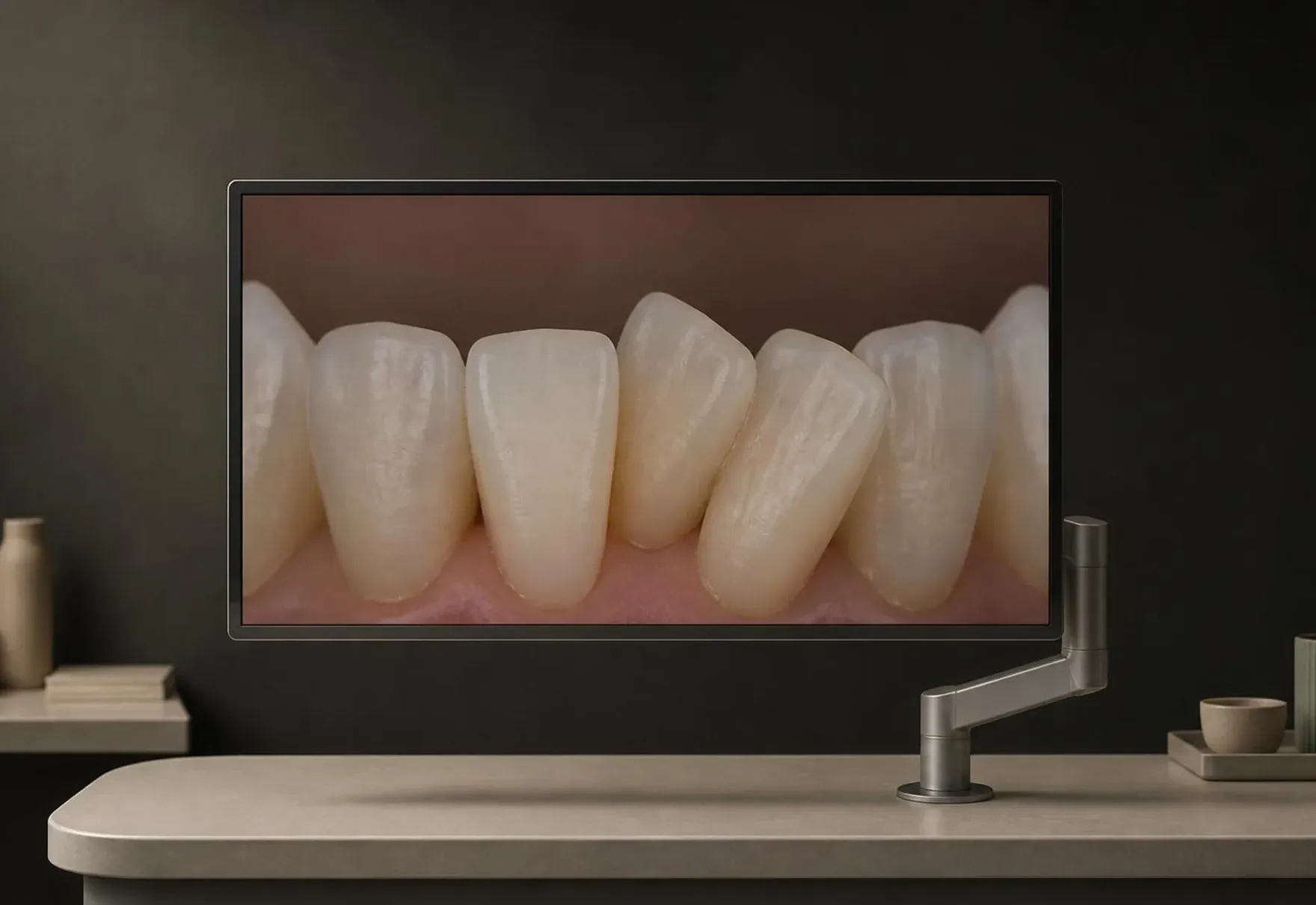
A great many adults arrive slightly embarrassed, convinced they wrecked a result by losing a retainer twenty years ago. Sometimes that is part of it. But lower front crowding in your thirties and forties is extremely common in people with no orthodontic history at all. Teeth drift forwards and inwards throughout life, and the lower front region is where it shows first. So the honest framing is that late crowding is largely just what teeth do, and even a perfectly worn retainer only slows it. This matters for two reasons. It removes the guilt, which is the thing most likely to have kept somebody from asking. And it sets a realistic expectation for afterwards: whatever we achieve is held by a retainer, permanently, because the same drift will still be there.
Why gum health matters more than your age
If there is one thing to take from this page, it is that adult orthodontics is a periodontal decision before it is an orthodontic one. Bone lost to gum disease does not come back, and applying orthodontic force to teeth in a mouth with active disease can accelerate that loss substantially. So the sequence here is not negotiable: full periodontal charting first, treatment and stabilisation if anything is active, and orthodontics after. We have a board-certified periodontist in this building, which means that sequence happens here — not as a referral and a wait. It also means the answer is sometimes that gum treatment comes first and orthodontics follows in six months. That is a delay worth taking, and a better outcome than a straight smile on a compromised foundation.
How gum health is measured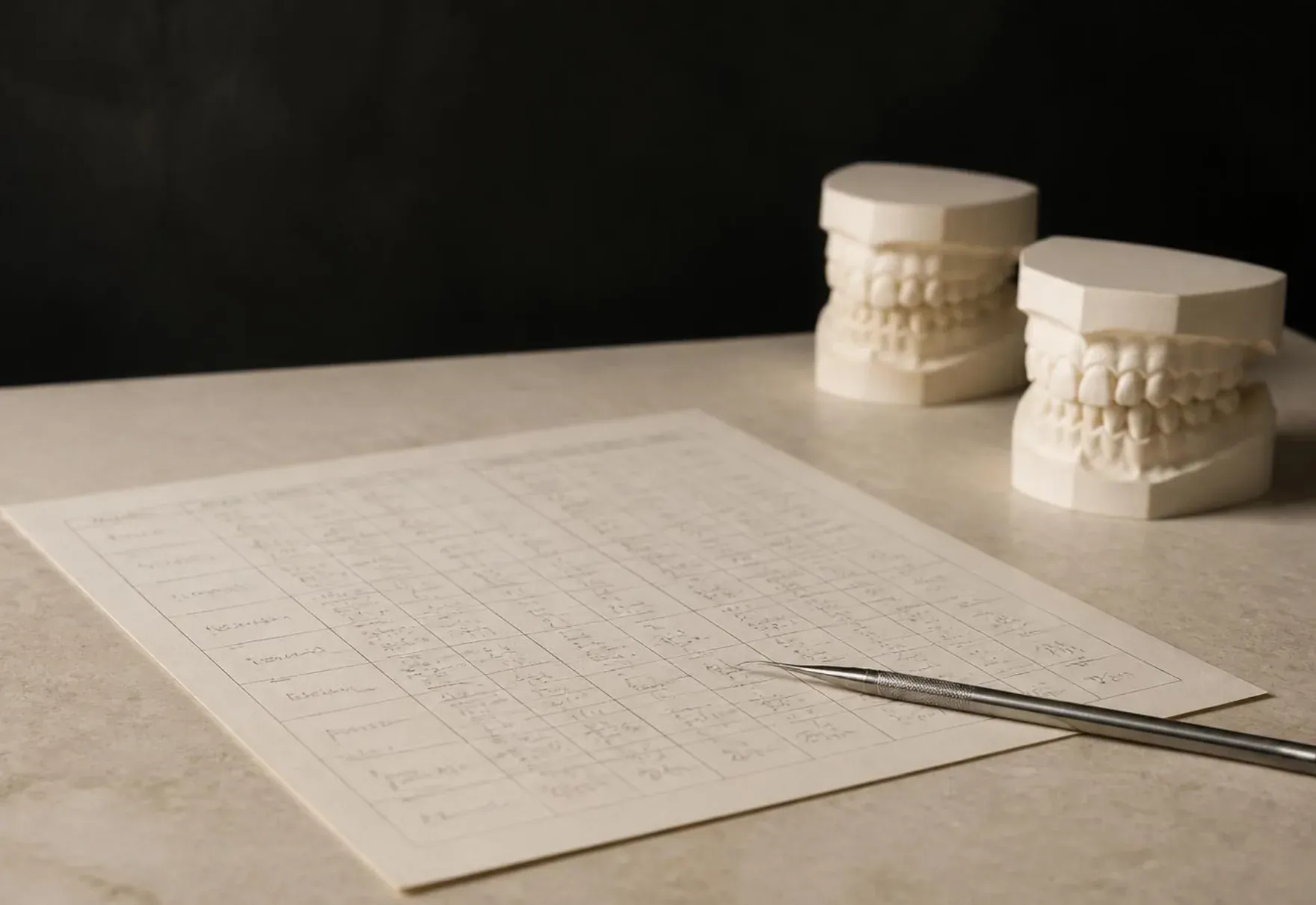
Adult orthodontic options compared
What is genuinely different, and what is not different at all.
| Feature | Same as a teenager | Different for an adult |
|---|---|---|
| Whether teeth move | Identical — biology does not change | — |
| Speed | — | Somewhat slower, and only somewhat |
| Gum assessment | — | Essential, and it comes first |
| Skeletal correction | — | No growth to use — limits some cases |
| Existing crowns and implants | — | Planned around; implants do not move |
| Appliance choice | Case decides — not age | — |
| Retention | Permanent either way | Arguably matters more — drift continues |
Teeth drifted back after braces as a teen?
Thinking about adult braces in Frisco, TX? At White Lotus Dental a gum check comes first, and then we look at braces or Invisalign for your case. This is one of the most common reasons adults come in, and almost everybody arrives apologetic about it.
You do not need to be. Retainer wear slipped for nearly everyone who was handed one at sixteen, and teeth drift throughout life regardless. What you are looking at is partly relapse and partly just thirty years of ordinary movement.
Two things worth knowing.
Re-treatment is often shorter than the original course. The teeth have been there before, and if the movement needed is modest, limited treatment can be a matter of months and not years. Getting that assessed costs you an appointment.
This time, the retainer is the treatment. Not an afterthought at the end of it. If you take one thing from having it done twice, take that. And if a nightly retainer sounds unrealistic for you, say so at the start. A bonded wire behind the lower front teeth does not depend on you remembering anything.
Braces and Aligners for Adults near Frisco, Prosper and Plano
White Lotus Dental is at 8175 Custer Rd, Suite A110, Frisco, TX 75035. Patients come to us from across Frisco and from nearby Prosper, Plano, Little Elm, Allen, Celina and McKinney. We are open Monday, Tuesday, Thursday and Friday from 9 AM to 6 PM and Saturday from 9 AM to 3 PM. We are closed on Wednesday and Sunday, although our team still answers the phone on Wednesdays.
If you are weighing aligners, read about Invisalign. Once treatment ends, retainers and relapse explains how to keep the result, and adults who have had gum disease will also want periodontal maintenance. For the full picture, see orthodontics and what orthodontics costs. Children’s Medicaid and CHIP are accepted here, and anyone without insurance can join our membership plan. To book a consultation, call (469) 262-2111 or request an appointment online.
Time in the chair for adult orthodontics.
The scale runs to five hours — the same scale on every page, so the bars are comparable across the whole site.
Adult braces cost in Frisco: what to expect
You get a written figure for each route that genuinely applies, with the expected insurance contribution and a monthly option.
You get the figure in writing before treatment starts. We accept all major PPO plans and file the claim for you, our membership plan takes a percentage off treatment, and CareCredit financing is available.
How plans usually cover adult orthodontics.
Orthodontics — its own category, with its own ceiling
- What plans pay
- Commonly 50%, up to a separate lifetime maximum of around $1,000 to $2,000. Read that again: this is a lifetime maximum. It does not reset every year the way the annual one does.
- Deductible
- Often a separate one-off orthodontic deductible, and on some plans none at all.
What catches people out
- Age limits. A great many plans cover orthodontics only up to age 19, some only to 18. Adult orthodontic coverage exists but it is much less common than people expect.
- A lifetime maximum does not come back. Once it is spent it is spent, on that plan and any future one that counts prior treatment — which is why a second course of treatment is usually paid entirely by the patient.
- Benefits are paid in instalments across treatment — not up front — so changing employer mid-treatment can stop the payments partway through.
- This is where the age limit bites hardest. A great many plans stop orthodontic coverage at 19, so adult treatment is very often paid entirely by the patient — worth establishing up front, before a plan is drawn up.
These are how dental plans usually classify this treatment — not a statement about your own plan. Yours is the one that governs, plans differ more than people expect, and the only reliable answer comes from reading your specific benefits, which we always do ahead of treatment and give you in writing.
And what changes out-of-network
A dentist who is in-network has signed a contract fixing what may be charged for each procedure and cannot bill you the difference. One who is out-of-network has signed nothing, so the full fee stands.
So the first difference is the price itself — the same treatment is simply allowed to cost more out-of-network, before anyone's plan is considered.
What you personally pay out of that depends on your own deductible and coinsurance, which is why there is no percentage here: it is not a property of the treatment, it is a property of your plan, and we verify yours before you commit. But two things follow for everybody. Your share is a share of a bigger number. And your orthodontic lifetime maximum is spent by what the plan pays toward that bigger number, so the same treatment eats more of your benefit out-of-network. That pot does not reset, which is what makes it bite.
An illustration, not a quote. These are the allowed fees for adult orthodontics — taken from our own contracted schedules. An allowed fee is what the contract permits to be charged, in network and out. It is not what you pay: your deductible and your coinsurance decide that, and we work yours out in writing before you commit to anything.
Check the going rate yourself
FAIR Health's dental cost lookup is free, needs no account, and is not ours — it reports what a procedure typically costs in your area. It does not know your plan, so treat it as a ballpark figure — not a final answer.
Ask us for the number first
We verify your specific plan before your appointment and give you a written estimate: what the plan is expected to pay, and what you pay. If we get it wrong we tell you why.
Bring an Explanation of Benefits
Treated somewhere else? Your EOB shows exactly what the plan paid and what it counted against your maximum. Bring one in and we will read it with you — whether or not you become a patient here.
None of this says out-of-network dentists are worse dentists. Plenty are excellent, plenty are out-of-network for sound reasons, and people choose a dentist for who that person is. What we think you are owed is the information, so that whatever you choose, you chose it knowingly. The whole thing, explained properly, or call (469) 262-2111 and ask.
- Hours
- Weekdays 9–6
Saturdays 9–3 - Languages
- English, Telugu, Hindi, Urdu
Arabic with Saba, our hygienist, Tuesdays, Thursdays and Fridays
Vietnamese with Anh, our hygienist, Saturdays
Cantonese and Mandarin with Dr. Louie, our periodontist, on his scheduled days, by internal referral
Questions Frisco adults ask about braces and aligners
Grouped so you can go straight to the one you came for.
Braces and Aligners for Adults — common questions
Am I too old for braces?
What is actually different about treating adults?
Why have my teeth got more crowded as an adult?
Can I have Invisalign as an adult?
I have crowns and an implant. Can I still have treatment?
I have gum disease. Does that rule me out?
Will my insurance cover adult orthodontics?
Should I straighten my teeth before getting crowns or veneers?
Is Invisalign good for adults?
Is it cheaper to get braces as an adult?
Where can I get adult braces near me in Frisco?
Toothache at 7am? You'll be seen today.
Same-day and Saturday appointments for toothaches, broken teeth, knocked-out teeth and lost crowns. Call us and we'll tell you what to do first, while you're still at home.
Everything else under this roof.
White Lotus Dental offers nine dental specialties inside one calm office on Custer Road. Having general dentists and an in-house periodontist on staff means your entire family can receive preventive, restorative, and surgical treatments in one familiar place.
Preventive Dentistry
Regular dental checkups, professional cleanings, night guards, and jaw-pain care. Every routine exam includes an oral cancer screening to protect your long-term health.
Explore
Children's Dentistry
Gentle first dental visits, protective sealants, fluoride applications, and space maintainers. We accept Children's Medicaid and CHIP, and every young patient receives a toy-machine token at the end of their visit.
Explore
Orthodontics
Clear aligners with Invisalign® and comprehensive traditional braces. Your treatment is fitted, monitored, and adjusted in-house by your trusted dentist.
Explore
Missing Teeth
Permanent dental implants, dental bridges, and customized dentures planned using 3-D CBCT scans. Because our team includes a board-certified periodontist, your implant surgery, placement, and final crown are completed in the same building.
Explore
Cosmetic Dentistry
Professional Zoom whitening, custom take-home whitening trays, and composite tooth bonding designed to brighten and refine your natural smile.
Explore
Periodontics & Oral Surgery
Specialized gum disease therapy, scaling and root planing (deep cleanings), frenectomies, and periodontal surgery performed by our board-certified periodontist.
Explore
Restorative Dentistry
Custom porcelain crowns, bridges, tooth-colored fillings, and full-mouth restorations crafted to match the natural look, feel, and function of your teeth.
Explore
Sedation Dentistry
Relaxing dental care tailored to your comfort level. We offer nitrous oxide (laughing gas) for any routine clinic visit, as well as oral and IV sedation planned ahead with our periodontist.
Explore
Emergency Dentistry
Toothaches, broken teeth, knocked-out teeth and lost crowns — seen the same day, Saturdays included.
Explore